
Comparison · AI agent operations
AxLoop vs. Braintrust
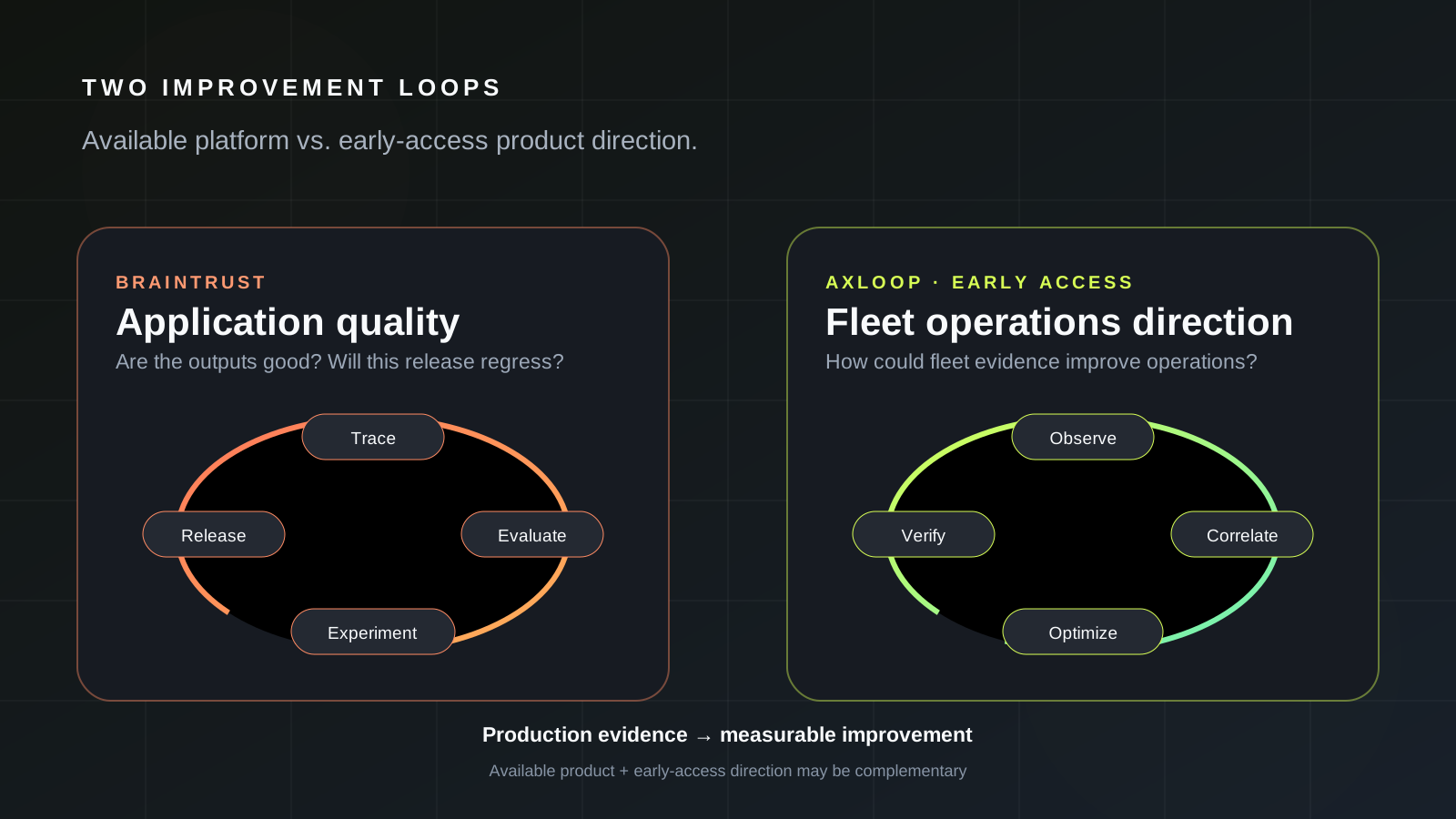
Braintrust offers production agent observability and evaluation today. AxLoop is early access: its product direction extends the improvement loop across the distributed agent fleet, including devices, MCP, tools, models, policy, cost, and operational outcomes.
Short answer
Choose Braintrust when you need production tracing, evaluation, and regression prevention now. Evaluate AxLoop as an early-access design partner when your operating problem spans users, devices, MCP servers, tools, models, runtimes, ownership, policy, cost, and outcomes. Some architectures may eventually use both layers; they are not feature-for-feature substitutes today.
Comparing AxLoop with Braintrust is useful, but only if the comparison begins at the right level. They overlap in traces, cost and latency evidence, tool activity, and continuous improvement. They are not currently feature-for-feature substitutes.
Braintrust describes itself as an active observability platform for instrumenting, understanding, evaluating, and improving AI products. Its public product and documentation pages connect production traces to datasets, scorers, experiments, online evaluation, and release decisions. AxLoop describes itself as an edge-first optimization layer for enterprise AI agent fleets. Its operating model starts on the devices and runtimes where agent work begins, then connects that evidence across MCP servers, tools, models, APIs, policy, cost, risk, and outcomes.
Based on the public evidence, Braintrust's most developed documented workflow is application and project tracing, evaluation, and release improvement. AxLoop claims a different scope: cross-device fleet inventory and operations. That is a useful comparison frame, not a hard boundary around either product.
At a glance
| Decision factor | Braintrust | AxLoop |
|---|---|---|
| Availability | Available now | Early access; Crawler in development |
| Best-documented workflow | Agent traces, evals, experiments, and release confidence | Cross-device fleet inventory and optimization direction |
| Instrumentation | Application SDKs, OpenTelemetry, and AI gateway | Planned client/device-edge capture and federation |
| Evaluation depth | Datasets, scorers, playgrounds, online scoring, CI gates | Goals, baselines, and outcome verification described at a high level |
| Fleet estate | Reviewed pages do not establish device inventory or shadow MCP discovery | Device, user, MCP, tool, ownership, and data-path scope claimed |
| Deployment | SaaS; Enterprise BYOC and customer-operated data plane | Customer-controlled aggregation described as product direction |
| Commercial proof | Public plans, signup, docs, and pricing | No public pricing, quickstart, or customer proof yet |
Where AxLoop and Braintrust overlap
Both products reject passive monitoring as the final outcome. Their public stories share a loop:
- Instrument an AI system and collect production evidence.
- Inspect traces, failures, latency, token usage, cost, and tool behavior.
- Find a pattern, regression, or operating constraint.
- Improve a prompt, model, tool, workflow, route, or policy.
- Measure whether the change produced a better result.
Braintrust is not “evals only.” Its instrumentation can capture nested agent traces, prompts, responses, tools, retrieval steps, tokens, latency, and cost. AxLoop is not “monitoring only.” Its stated objective is to use complete fleet evidence to make a bounded improvement and verify the outcome.
Braintrust currently offers Enterprise BYOC and customer-operated data-plane deployments while retaining a Braintrust-operated control plane. AxLoop describes local-first collection and customer-controlled VPC or on-premises aggregation as product direction, not established availability. Private deployment is therefore not an AxLoop-exclusive claim, and the two models should not yet be treated as equivalent.
Braintrust's documented strength: agent quality and release confidence
Braintrust positions itself as an observability platform for agents, not merely an eval tool. Its most developed documented workflow combines production agent traces with a focused question: Are this application's outputs good, and will the next release make them worse?
Teams can turn production logs and feedback into datasets, define code-based, model-based, or human scorers, compare prompts and models in a playground, and record immutable experiments. Online scoring measures live traffic; CI/CD integrations can block a regression before release. Its Observe and Discover products add searchable traces, dashboards, alerts, annotations, semantic clustering, and natural-language analysis. Braintrust also documents OpenTelemetry support, custom metadata, pre-send masking, MCP-facing workflows, and nested agent tool calls.
That makes Braintrust a strong fit for AI engineers and product teams iterating on response quality, retrieval quality, task success, safety, and release confidence. It has public signup, extensive documentation, and published plan tiers today.
Read Braintrust's official pages on production observability, evaluation, pattern discovery, and CI evaluation.
AxLoop's claimed scope: the distributed agent fleet
AxLoop starts from a cross-estate operating question: Across which users, devices, MCP servers, tools, models, and environments is the agent estate running—and how could the enterprise safely improve the fleet as one system?
The AxLoop Crawler is designed to create the first useful span where agent work begins: a laptop, phone, IDE, private desktop, branch, factory, embedded system, or other edge runtime. It is intended to preserve the initiating agent, user, device, tool, MCP, policy, cost, and downstream context that a server-only view may not be able to reconstruct later.
AxLoop is designed to roll evidence up across the fleet to support inventory and ownership, shadow MCP discovery, tool-call and data-flow analysis, cost attribution, policy context, and fleet-wide optimization. Its intended loop is to find the highest-value operating constraint, route a bounded change through the right control, measure the result, and retain only improvements that work. These capabilities require validation in an early-access design-partner evaluation.
Read AxLoop's official pages on the optimization loop, edge-first architecture, and shadow MCP discovery.
The key differences
1. The strongest documented workflow
Braintrust's public product is strongest and most detailed around agent and application traces, outputs, datasets, scores, experiments, and releases. AxLoop's early-access product claims extend to the fleet estate: agents, users, devices, MCP servers, tools, models, runtimes, owners, policies, downstream systems, costs, and outcomes. This describes the reviewed public evidence, not an immutable category line.
2. Where evidence begins
Braintrust publicly documents application SDK instrumentation, OpenTelemetry, custom metadata, masking before data is sent, and an AI gateway. AxLoop's early-access direction emphasizes creating the first span at the client or device edge, including offline buffering and local redaction, before federating evidence into customer-controlled infrastructure. Braintrust's reviewed public pages do not establish device-fleet inventory or shadow MCP discovery; that is an evidence limit, not proof that no adjacent capability exists.
3. Evaluation depth
Braintrust has the more developed public evaluation story: datasets, multiple scorer types, playgrounds, experiments, online scoring, and regression gates. AxLoop talks about goals, evaluation criteria, baselines, and verified outcomes, but its public site does not establish a comparably detailed application-evaluation suite.
4. Governance and operational scope
Braintrust's available product emphasizes quality scores, annotations, alerts, and release decisions. AxLoop's stated direction emphasizes inventory, ownership, policy context, approvals, reversibility, unmanaged MCP risk, and measured operational changes across the fleet. These are related controls at different layers of the enterprise problem.
5. Current maturity
Braintrust is available now with public signup, documentation, and published plan tiers; BYOC and customer-operated data-plane deployment require Enterprise. AxLoop is early access and has no public pricing. Its Crawler is in development, the self-hosted optimization layer is described as next, and policy and governance capabilities are planned. Public customer proof, a quickstart, and detailed implementation documentation are not yet available.
Which one fits your team?
Choose Braintrust first when:
- Your central risk is output quality or a release regression.
- You need datasets, scorers, experiments, and CI evaluation now.
- Your main operating unit is an AI application or product workflow.
- You want a mature, documented platform with self-service entry.
Consider an AxLoop design-partner evaluation when:
- Your agents operate across devices, edge runtimes, private systems, and clouds.
- You want to validate cross-device MCP inventory, ownership, and data-path claims.
- You need to test whether fleet evidence can connect cost, reliability, risk, and outcomes.
- You can evaluate an early-access operating loop against measurable success criteria.
Use both layers when:
Your application teams need rigorous evals while your platform and security teams need fleet-wide inventory, context, policy, cost, and optimization. In that future model, Braintrust could measure whether an application change improves quality while AxLoop could connect that change to the broader device-to-outcome operating path. This is an architectural possibility, not a claim of available capabilities or a packaged integration today.
A note on evidence and fairness
This comparison uses the products' public websites and documentation as of August 25, 2026. Braintrust has substantially more public implementation detail and market availability. AxLoop's capabilities are early-access product claims and should be validated in a design-partner evaluation before a production decision.
Conversely, absence from a reviewed Braintrust page is not evidence that Braintrust can never address an adjacent fleet problem. Buyers should test both products against a real workload, deployment boundary, security model, and measurable success criterion rather than selecting from category labels alone.
Additional official sources: Braintrust instrumentation, deployment, and plans and limits; AxLoop MCP tool-call observability and product-status disclosure.
Evaluate the fleet-operations layer.
If your AI agents span devices, MCP servers, tools, models, private systems, and cloud environments, bring us a real operating constraint. We'll map the evidence required to measure and improve it.
Request early access